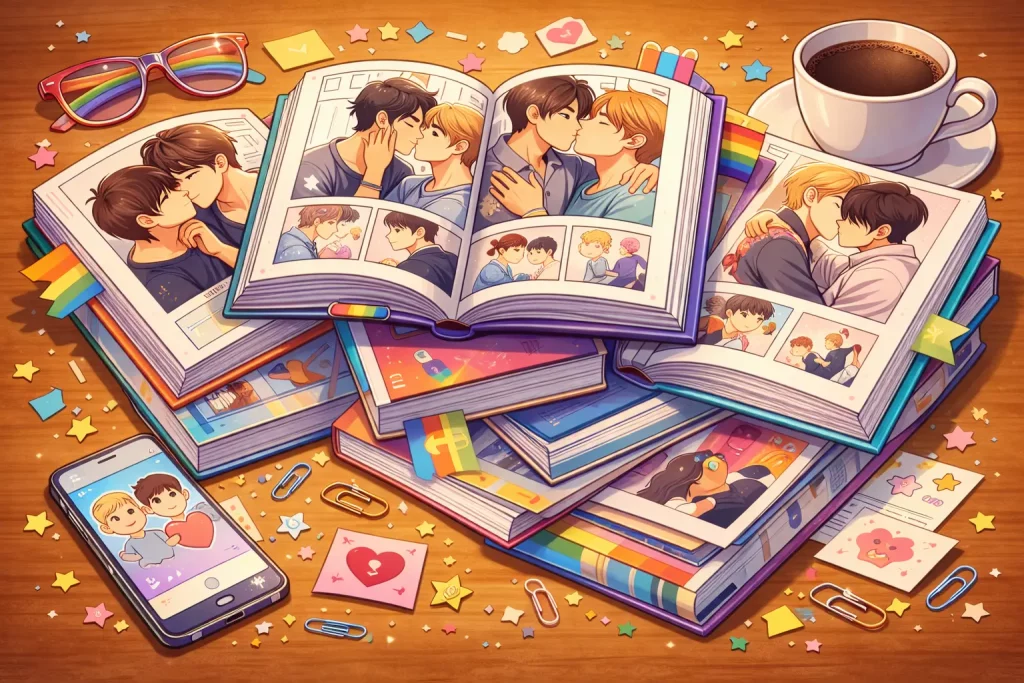
I like stories that feel true. I also like messy teens, found family, and clean line art. So I spent a few months reading gay manga. On the train. On my couch. Even at my mom’s kitchen table, which was a bit funny.
If you’d like the concise version from that journey, I’ve collected it in this reflection.
Some of it made me laugh. Some of it made me cry like a soft peach. And yes, a few books got too steamy for my taste. You know what? That’s fine. I’ll tell you where each one lands, so you can pick what fits your mood.
What I Look For (and What I Don’t)
I care about three things:
- Story that respects queer life
- Art that matches the tone
- Clear age rating, so I’m not shocked on page 47
I’m okay with romance. I’m not okay with harm played for jokes. I also like good typesetting and notes from the translator. Nerdy, I know.
My Brother’s Husband by Gengoroh Tagame
This one hit me hard. It’s about Yaichi, a single dad in Japan, and Mike, the gentle Canadian man who was married to Yaichi’s twin brother. If you’re curious about how critics have discussed the book’s handling of grief and prejudice, this Guardian review offers a thoughtful overview. Mike visits. He cooks. He hugs. He tries. The little girl, Kana, steals the show.
- What I loved: It’s warm and brave. It talks about grief, family, and bias, but in a calm way. The paneling is square and clean. The line work is bold. It feels like a deep breath.
- What I didn’t: It can be slow. A few scenes feel like a lesson plan. But I didn’t mind. I cried more than once.
- Heat level: Low. Think hugs and hard talks, not bedroom scenes.
- Who should read it: Folks new to gay manga. Parents. Anyone who likes quiet stories that still punch.
Classmates (Doukyusei) by Asumiko Nakamura
Two boys meet in music class. One is messy. One is neat. They sing. They fall in love in soft steps. The art is light as tissue paper—long limbs, white space, tiny eyes that still show a lot.
- What I loved: The mood. The silence. The teen ache that feels real, not fake. I could hear the guitar.
- What I didn’t: It’s airy. Sometimes a scene jumps, and I had to flip back. Faces get abstract. I liked it anyway.
- Heat level: Sweet and gentle.
- Who should read it: Readers who like poetry, sketchbook lines, and that first-love flutter.
Go For It, Nakamura! by Syundei
This one is pure joy. It looks like a ’90s gag comic, in the best way. Nakamura is a shy gay teen with a crush on a boy named Hirose. He tries so hard. He plans. He panics. I laughed on the bus and got stares. Worth it.
- What I loved: The timing. The faces. The way it lets a gay kid be silly and kind, not tragic.
- What I didn’t: It’s light. If you want big plot, this isn’t that. The romance moves like a snail on a sunny day.
- Heat level: Very low.
- Who should read it: Anyone who needs a smile. Great starter book. There’s also a sequel.
Our Dreams at Dusk: Shimanami Tasogare by Yuhki Kamatani
This series is special. It follows a teen boy who meets a quiet queer group at a place nicknamed “The Lounge.” People there include a trans woman, a nonbinary person, a lesbian couple, and others. It’s not only gay; it’s a whole community. The art is stunning—waves, bricks, shadows, hands, all full of feeling.
- What I loved: It treats everyone with care. It shows pain, but also joy and craft and daily life. I felt held.
- What I didn’t: It’s heavy. It talks about outing and even suicide. I had to pause between volumes.
- Heat level: Low. It’s about identity and hope.
- Who should read it: Teens and adults who want depth. Maybe read with tea. And tissues.
Blue Flag by Kaito
At first, I thought it was straight romance. Then it surprised me. It’s a story about three friends and a lot of mixed feelings. One boy likes another boy. The book lets that grow slow, with doubt and courage.
- What I loved: Kind writing. Big questions. The way it shows how friends change.
- What I didn’t: It can drag. Some drama feels like it loops. But the end stuck with me.
- Heat level: Low to medium, mostly talk and tension.
- Who should read it: Readers who enjoy school stories and long, messy arcs.
Given by Natsuki Kizu
Band boys. Grief. A guitar that won’t stay quiet. I read the first volume in one night. The music scenes sing off the page. The romance builds as they practice and write. I could almost hear the amp buzz.
- What I loved: The way loss turns into song. The small looks. The hair and hands are drawn with care.
- What I didn’t: Later volumes get more adult. Some poses feel stiff. Not a deal-breaker, just a note.
- Heat level: Medium to high in later volumes. Check the rating.
- Who should read it: Music lovers. Folks who like romance with a stage light on it.
Quick Hits If You’re Short on Time
- I Hear the Sunspot by Yuki Fumino: Sweet slow-burn between two college guys; one has hearing loss. Low heat, high heart.
- My Summer of You by Nagisa Furuya: Light and sunny. Like a day at the pool. I smiled a lot.
- Twittering Birds Never Fly by Kou Yoneda: Dark crime drama. Very adult. I respected it, but it’s not my comfort read.
For an even broader shelf of titles centering queer leads across genres, take a look at our roundup of books with a gay protagonist; it pairs nicely with the manga picks above.
Art, Heat, and How to Pick Without Guessing
Here’s the thing: “BL” can mean a lot. Some books are soft and PG. Some are very adult. If you’re shopping:
- Check the age rating on the back. It helps.
- Flip to the middle. Look for tone, not spoilers.
- Peek at the publisher. Seven Seas, VIZ, Yen Press, and Kodansha handle a lot of these. Their labels are pretty clear.
- If you’re sensitive to certain topics, search “content warnings” with the title. Saved me a few times.
For extra guidance, I like to browse the in-depth title indexes on Gay Book Reviews, where heat levels and trigger notes sit side by side.
A quick craft note: I care about lettering. Clean typesetting makes dialogue easy to follow. Sound effects matter too. When the localization keeps a guitar “twang” or a soft “shff,” I feel it. Nerd corner, sorry.
On the other hand, if what you really want is content that dives straight into explicit adult territory—with no guessing about where the fade-to-black ends—you might step outside the manga world for a moment and browse this curated list of completely free sexual material, which organizes videos and stories by theme so you can explore safely and at your own pace. If you’re curious about taking that exploration offline and into a real-world setting, you can also consult this Germantown Rubmaps guide for detailed, user-generated notes on local massage spots, their levels of discretion, and the etiquette expected inside—helpful intel before committing to an appointment.
Where I Read and Buy (And Sometimes Borrow)
I like print. I like the paper smell and the weight in my bag. Local indie shops have good staff picks. Chain stores are fine too, but the queer shelf can be thin.
I also use my library card. Hoopla and Libby often carry manga. The wait list can be long, so I place holds and forget them. Then one day—boom, four books at once. A nice problem to have.
So… Which Should You Start With?
- Want cozy and kind? My Brother’s Husband.
- Need a smile? Go For It, Nakamura!
- Crave art that hits the soul? Our Dreams at Dusk.
- First-love feels? Classmates.
- Music plus romance? Given.
- School drama with layers? Blue Flag.
Honestly, there’s no one path. Try one. See how it sits in your chest. If it feels right, keep going.
A Tiny Personal Note
I read most of these during Pride month, with a cheap fan buzzing and iced coffee sweating on my desk. I felt seen. Not in a big, shouty way. In a quiet way, like someone set out a chair and said, “Sit. Stay awhile.”
Some books taught me